
Republished with permission from the Spring 2016 issue of Fourteener Motoring Magazine.
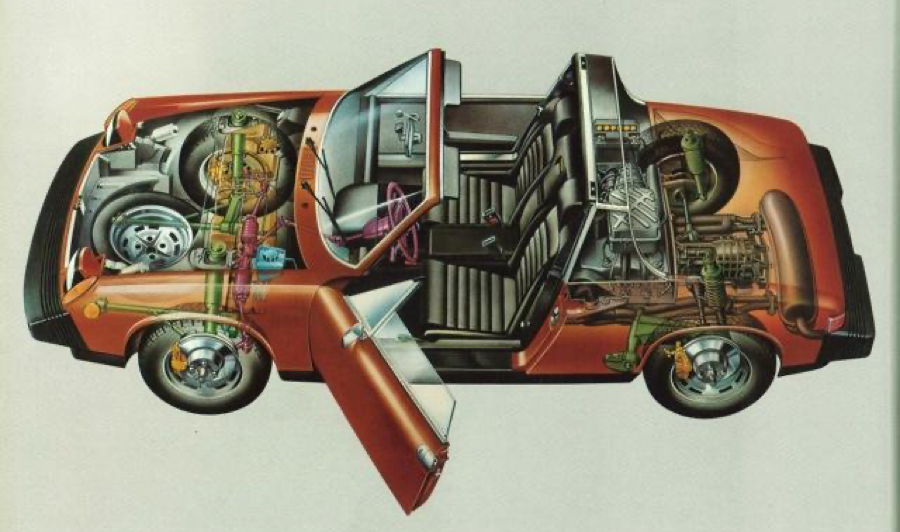
When the Porsche 914’s development got underway it had three primary criteria. First, the project would be a joint venture with Volkswagen so as to complete an existing contract under which the two companies had collaborated for years. Second, the car would be an inexpensive Porsche and at the same time replace the Karmann Gia for Volkswagen. Third, the design called for a mid-engine layout.
In continuing with the joint venture nature of the project, the car was to be designed by Porsche and powered by VW. The head of research and development at Porsche, Ferdinand Piëch, was put in charge of the new project. Much of the design work was done over the autumn of 1966, with the design group being led by Heinrich Klie and Ferdinand Alexander Porsche. By early 1968 the first prototype was complete. And on March 1, 1968, the first prototype 914/4 prototype was driven.
Ferdinand Piëch also had his technicians fit a 3-litre, flat-8 fuel injected engine, from the Porsche 908 racing car program, in one of the prototypes. The Piëch Blood Orange 914/8, as it has become known, had wider headlamp housings which featured quad lamps. But the differences between the prototypes and the 914 that would ultimately come off of the assembly line don’t stop there. Although the prototypes are both similar, yet very different, than the production car, when viewing the Piëch 914-8, it is easy to see the engineers working toward the the final production car. Today the famous prototype is in the Porsche museum in Germany.
On April 12, 1968, the 914 project suffered a major set back, when the Volkswagen Chairman, Heinz Nordhoff, died. The two companies had operated on a verbal agreement for years. However, with VW being led by Nodhoff’s successor, Kurt Lotz, the agreement between the two companies began to fall apart.
Initially, the four cylinder version 914 was intended to be sold worldwide as a VW. The six-cylinder version of the car was to be a Porsche. The agreement for Porsche to use the same design to produce the 914-6, with the Porsche engine, however, was not in writing. This important detail had been a verbal understanding between Nordhoff and Ferry Porsche. Under the written agreement between the companies, Porsche was commissioned to do the design and devleoopment of the car, but nothing more. VW had exclusive rights to the car.
With Lotz at the helm, VW pushed Porsche to share the tooling costs of the car, and the company from Stuttgart resisted. The issue was eventually resolved in late 1968. The compromise, however, changed the way the car would be marketed, as well as the cost basis of the 914-6 bodies going to Porsche.
As a result of the compromise between the companies, by mid-1969 the marketing company VW-Porsche Vertriebsgesellschaft mbH was formed to help with marketing and sales for the joint venture. Porsche and VW each had a 50% share in the company. From then on, the sales operations for the 911, 914-4 and 914-6 were carried out by the marketing company.
When the 914 was introduced on September 11, 1969 in Frankfurt, it was sold in Europe as a VW-Porsche and in the U.S. as a Porsche.
This decision stemmed from the new agreement between the companies. In the new agreement, Lotz insisted that VW would only make bodies available to Porsche, if both companies agreed that all new 914s be designated as a VW-Porsche. His hope was that the high-end name recognition of Porsche would benefit VW in general. Under the agreement, however, in the U.S. all 914s, both four and six-cylinder models, would be sold under the name Porsche.
The difference in names in the U.S. versus Europe, as well as the VW engine in the four-cylinder models, plagued the 914 with confusion over its lineage for many years. In a now famous defense of the 914, Chuck Stoddard, the then PCA technical chairman, compared the 914 to the orignal 356s, which carried many VW parts. Based on that comparison, having been designed by Porsche with a clean sheet of paper, the 914 was indeed more Porsche than the original cars built in Stuttgart.
Another significant change to the overall circumstances surrounding the introduction of the 914 was related to the cost of the 914-6 offered by Porsche. When the two companies negotiated the delivery of 914-6 bodies to Porsche, under their new agremeent, VW required that Porsche pay more for the bodies than it was paying for the more complicated 911 structure.
With the increase in costs, Porsche was forced to increase the price of the 914-6. When the car hit showrooms its pricing fell just below that of the company’s flagship model, the 911. On the east coast the six sold for $5,999, while its price was $6,099 on the west side of the U.S. At these prices, the 914-6 cost within $500 of a 911.
Both the 914 and 914-6 sat in a very precarious positon. The base four-cylinder 914 was inextricably tied to VW, which confused its image in the eyes of buyers. And the six-cylinder version took on a market position in between the four-cylinder model and the 911. On the one hand the six was much faster than a four-cylinder 914. On the other hand, though, it was not as desirable as a 911, which could be purchased for slightly more money. There was nothing Stuttgart could do to change the image of the four-cylinder or the pricing of the six. They were already making less profit on the 914-6 than they enjoyed on the 911.
Despite the setbacks, as well as name and pricing challenges, the production of the 914-4 started in 1969 (as model year 1970) and the production of the 914-6 begina in 1970. The initial plan was to produce 30,000 914 bodies per year. Of those, 7,500 would be delivered to Porsche to become 914-6s. As it turned out, however, these numbers would not hold.

About The Author: Steve
More posts by Steve