
By Steve Turcotte. Republished with permission from the Spring 2016 issue of Fourteener Motoring Magazine.
Are you enjoying the spring months and the chance to drive your 914? Or are you one of the lucky souls that gets to drive your 914 year round? There is a basic inequality between 914 owners. It is entirely predicated on geography. Some owners have to make the decision as to when to winterize and hibernate their car for the winter. At the same time, others drive their cars year-round and don’t understand the whole concept of hibernation. Still others, like myself, live in an “in between” location, that can allow for limited year-round driving, if the stars align.
The stars were all out of whack last winter, as ‘betty’ and I suffered through a brutally cold and excessively snowy winter here in Cincinnati. In other years, we have seen little snow, and temperatures in the 50s all winter long.
The problem isn’t the snow per se, the roads can be cleared and dry in short order after a storm. It isn’t the outside air temperature, either. I find that my 914 runs very well in cold, dry air. Rather, the issue is really the road salt.
In my area before the snow, they spray a wet slurry of brine on the dry roads which helps keep them drivable after the snow starts falling. With the mixture put down the plows can clean the roads easier. After the snow starts accumulating and the plows start mounding huge piles of snow, they also spray granulated salt from the aft spinner.
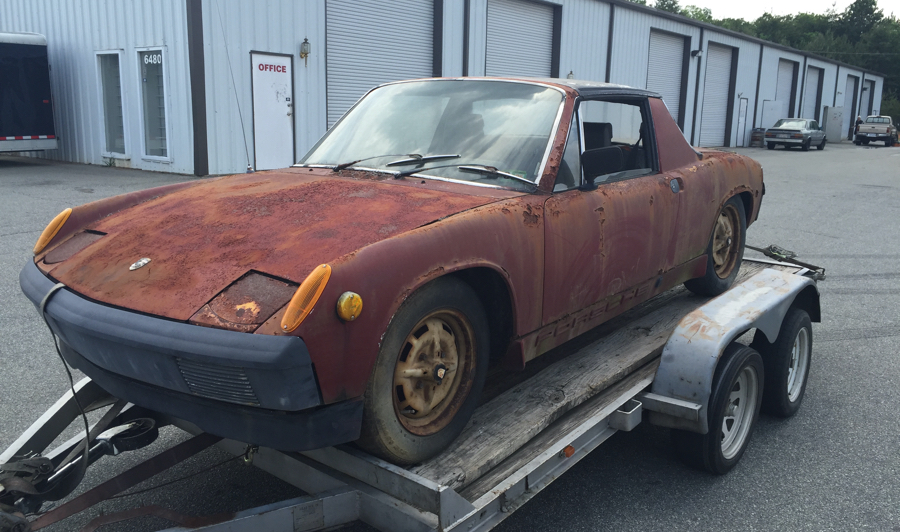
On a 40-year-old car that was typically delivered new with some rust, you really have to consider if you want to drive a rust magnet in these conditions. Floor pans, hell hole, rear trunk. It is almost as if these cars attract water.
When I lived in Connecticut they didn’t use salt, they used sand, which wasn’t really effective, and really caused problems when riding my motorcycle in the spring time. But it was much less rust-inducing. I didn’t own a 914 then.
While living in South Florida with my 914, I didn’t have to worry about snow, or cold. But, ironically, I still had to consider the salt air. That was also when I learned what ‘vapor lock’ meant. So while I didn’t have to hibernate my 914, I still found myself checking the weather before driving, only this time in July and August versus January and February.
I’m sure there is an ideal location to own and operate a 914. It’s probably located somewhere in the southwest corner of the US, or possibly some equally arid portion of Europe. I hear tales of year-round driving in mostly ideal conditions, on deserted and impossibly curvy roads. But, these are mostly myths, like the great white whale. But I didn’t come here to write about driving nirvana. I want to talk about ownership inequality and rust.
I purchased my current 914 from a little old lady in Palm Springs, California. At least that’s what the flippers told me. However, they were unable to substantiate their claim. Palm Springs is one of the Mecca’s of rust-free classic cars. I’m told. But yet even there, even in the desert southwest, my 914 was delivered to me with rust. I can only assume it’s the factory original type of rust, since it could not have materialized in Palm Springs.
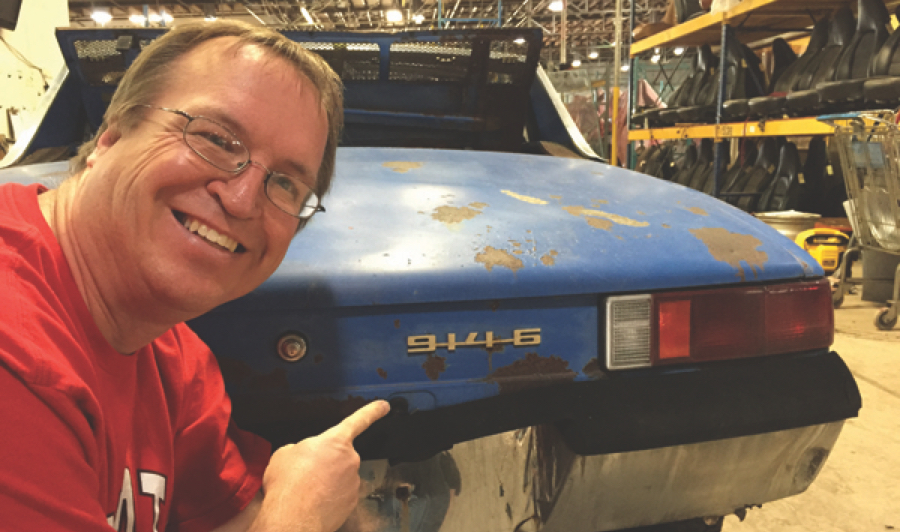
I see advertisements of 914’s for sale that categorically state – “No Rust.” However smarter men then I have declared that such a whale does not exist. Of course there must be rust-free 914’s out there somewhere. Ones that have just finished a complete restoration, been sandblasted to dust, welded back to shape, primed, painted, and clear coated. They do exist. I know because I’ve seen pictures of them on the internet. The question is – Does an unrestored rust-free 914 exist? I have to say, fairly confidently, no. The rust is there, somewhere . . . . in the tunnel, in the longs, under the fuel tank . . . . it’s there somewhere.
Of course it’s not always called rust. It is sometimes referred to as patina, or weathering, or OG paint. But it is rust. On a 914 rust doesn’t need salt, or rain, or bad seals, or even outside storage to grow. It just needs time. And on our cars, it has had 40 plus years to gain a foothold, and grow and mutate until we can no longer ignore it.
I’ve been thinking a lot about rust recently, as you can tell. On an OG car from Palm Springs, I have heard a lot of advice regarding rust. These cars are only original once, they say. And restoration is a slippery slope. Or so I’ve been told. I don’t believe there is such a thing as ‘minor’ rust. Because of the nature of rust, it is alwasy a problem. But some rust is worse than others . . . . probably it’s upbringing.
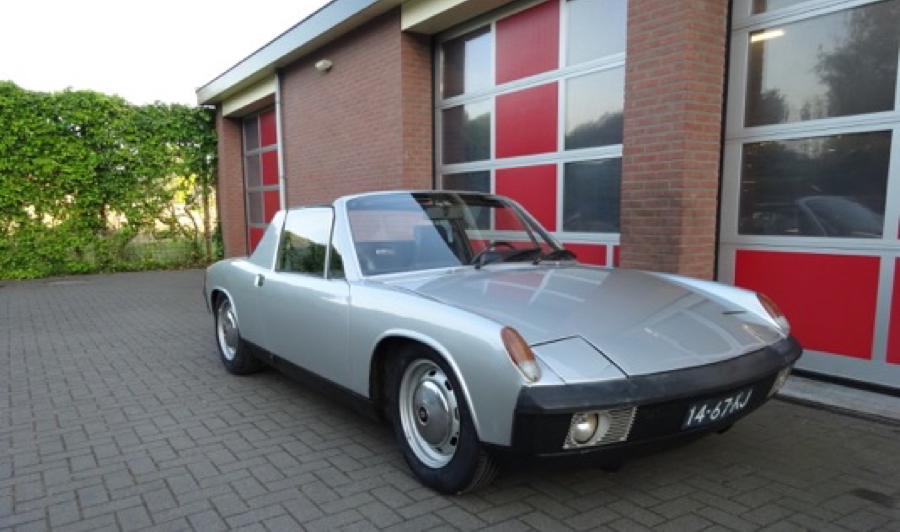
I’ll tell you what I’d like to do. Take every part off my car, strip ol’ Betty bare. Strip her paint down to bare metal, repair every blemish, paint every surface in her L80E Light Ivory color, while having the engine and tranny restored to factory new condition. Then bolt on only NOS parts from the magical parts bin that exists at the end of the rainbow. I would have myself a factory new 1973 Porsche 914 2.0, complete with the Appearance Group package. I’d love to do that. But of course, I’d have to add back the factory rust.

About The Author: Steve
More posts by Steve